
Iran On Edge
The debrief behind the footage: loud streets, louder system

Dear readers, good morning,
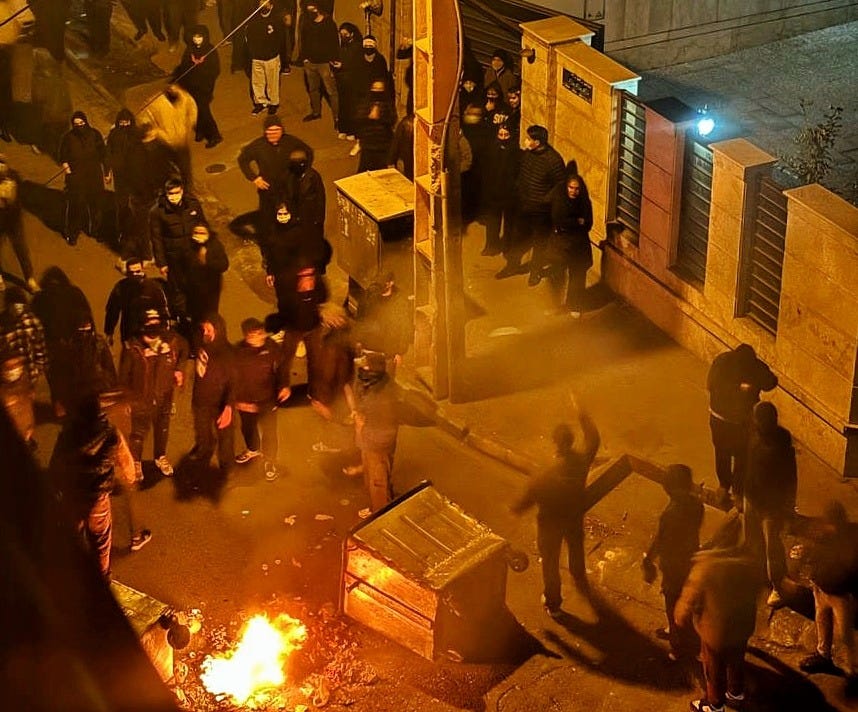
This week, Iran is the story. If you’ve been on Instagram or TikTok, you’ve seen it: crowds in the streets chanting defiance, met by a state responding with brutal force. So, what’s really happening in Iran, and is this finally the moment?
Since 1979, the world has asked this again and again: the 1990s, the 2009 Green Movement, the 2022 Woman, Life, Freedom protests. Each time, the Islamic Republic looked cornered. Each time, it survived.
What about now? Let’s debrief.
The IRGC State
The Islamic Republic is an architecture, and at its core sits the Islamic Revolutionary Guard Corps, the IRGC. People often call it a “security force” but that’s too small. The IRGC is a state within the state, embedded in intelligence, military strategy, and the economy. Why is that a problem? Because it’s mixed into everything: defense, energy, transportation, construction, business holdings… you name it. When coercion is paired with economic control, the regime can repress, reshuffle, and keep its base loyal.
That is why, historically, protests alone have not been enough: they are necessary, but change usually requires elite splits, cracks in the security apparatus, or a break in the coalition sustaining the system.
A Tipping Point Moment
This 2026 wave of protests feels like a tipping point. Economically, it’s driven by a cost-of-living crisis, inflation, currency weakness, and daily life becoming unlivable. Socially, it’s fueled by humiliation, anger, and a system that offers no path to dignity. Politically, it’s unfolding in the shadow of last June’s Israel–Iran escalation, which has hardened the regime and made it even more allergic to unrest1. Externally, the U.S. is losing patience, and Israel is willing to go as far as it needs to secure its interests.
The protests started two weeks ago in Tehran’s bazaar then spread quickly beyond the capital and into rural areas, where it became much harder to contain. The state’s response has been brutal: arrests, internet blackouts, and intense violence. Local reports put the death toll in the 2,000–12,000 range. Whatever the final count, the story repeats itself: the regime chooses violence repeatedly, but people return bravely anyway.
The Missing Middle
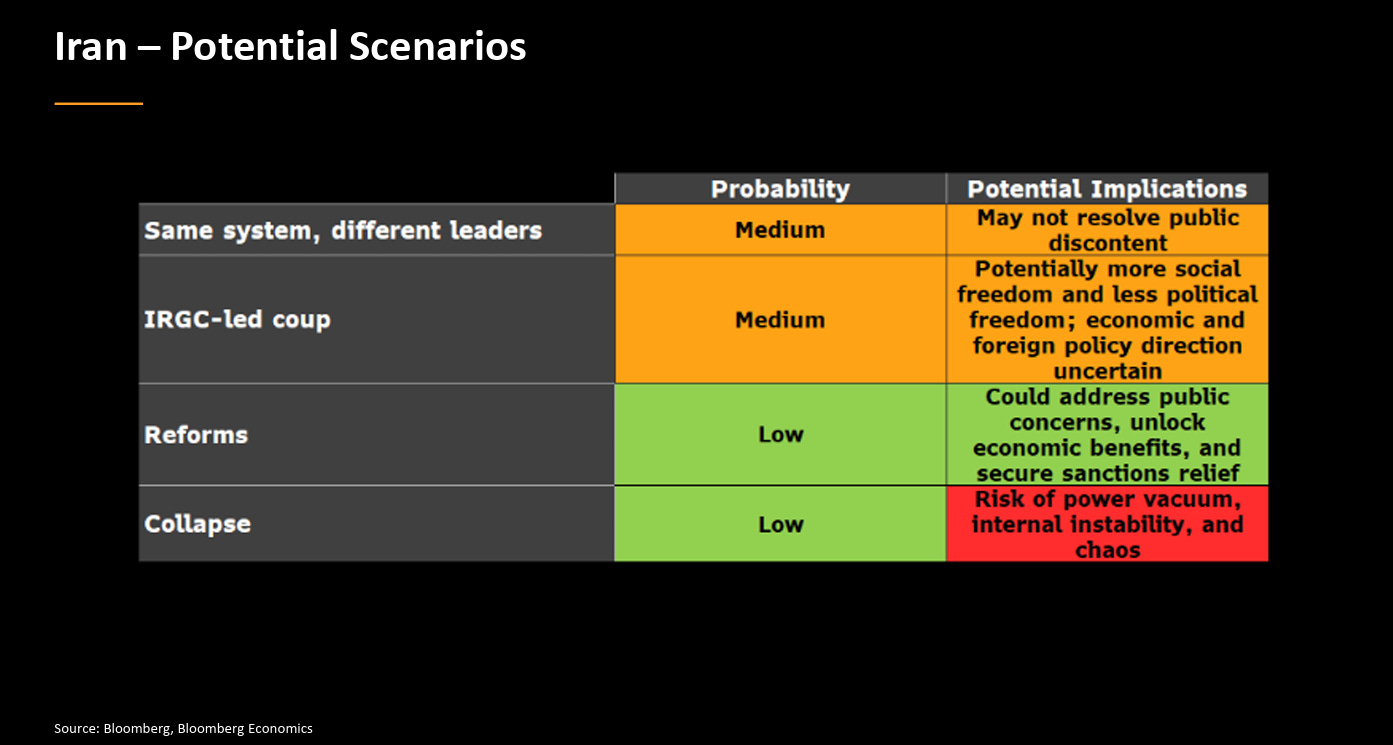
On Wednesday, Jan 14th, I attended a Bloomberg Economics webinar on Iran’s unrest. Iran expert Dina Esfandiary laid out four scenarios; the blunt takeaway was that the two most likely are not the hopeful ones. Both keep the system alive: either the same regime with different faces at the top, or a power shift from within the regime itself, led by the IRGC. True reform or full collapse were presented as much less likely.
The biggest constraint is the political opposition vacuum. The streets can be powerful, but as of today, there is no unified, credible opposition ready to turn protest into transition. People reach for symbols, or something to hold onto, and Reza Pahlavi is the most visible figure abroad. But visibility isn’t organization, and diaspora support isn’t a domestic coalition. Even if the regime cracks, the next question hits immediately: what comes after, and who holds the state together long enough to avoid fragmentation?
Donald Trump seems to grasp that in his own way. When asked about Pahlavi, he brushed it off: “I’ve watched him, and he seems like a nice person […] I think that we should let everybody go out there, and we’ll see who emerge”. This is how this White House thinks: fewer ideals, more pragmatism.
The Washington Variable
Yes, the domestic story matters: the IRGC’s grip, the scale of repression, and the absence of a unified alternative. But the biggest variable isn’t in Tehran; it’s in Washington. That same Wednesday night, the mood swung fast: one minute, the U.S. looked close to striking; the next, the temperature dropped. Trump said it was because Iran wouldn’t hang protesters. We all know that can’t be the real reason. The deal-maker doesn’t suddenly become a human-rights activist. If anything, it points to potential talks, with the nuclear file and the China question at the top of the agenda. Arab capitals pushed hard for de-escalation, urging restraint and warning Washington about spillover and oil shocks and pushed for the U.S. to give time for talks with Iran2.
That’s why, politically, the lack of a viable opposition plus the possibility of a Trump deal reduces the odds of immediate regime change. Venezuela showed us that Trump isn’t necessarily trying to remake regimes; he’ll deal with the same people as long as they bend. (One caution: U.S. and Israeli priorities on Iran can diverge: Israel prioritizes deterrence; Washington is also balancing oil markets, China, and wider-war risk.)
Energy Security Repriced
If the regime felt it had nothing left to lose, it could pull the region’s most explosive lever: the Strait of Hormuz. Roughly 20 million barrels a day move through it, about 20% of global petroleum liquids consumption3. These threats could push oil prices up instantaneously. But the fact that Tehran hasn’t seriously threatened it (yet) is a main reason markets haven’t priced a true energy shock. Traders are watching for real disruption, not just reacting to headlines.
In this Iran story, China is among the most exposed. 12% of China’s oil imports came from Iran last year, and China takes most of Iran’s seaborne crude (over 80% in 2025) because it’s discounted4. That discounted oil is part of China’s energy security model, alongside discounted barrels from Russia and Venezuela.
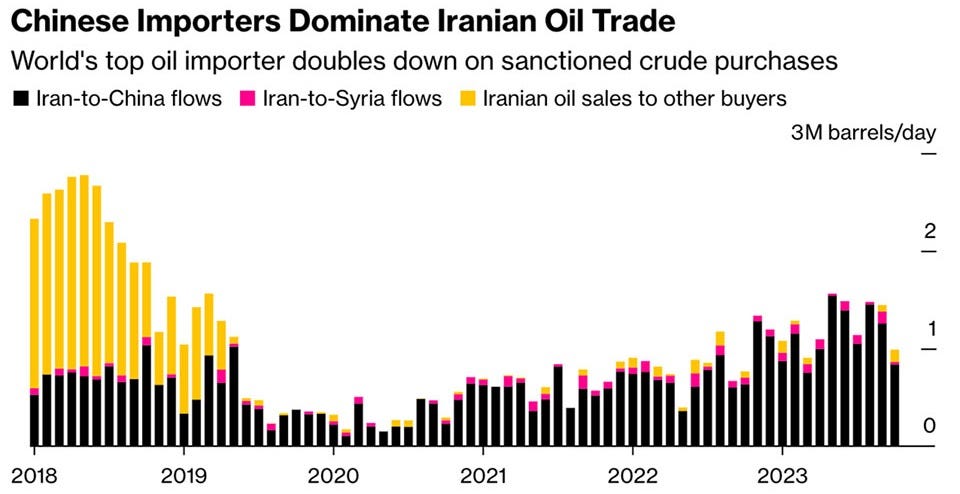
So, when Washington goes after two of those three at once, and if Trump strikes a deal with Iran’s future power-holders, it tightens the screws further. China loses a cost advantage, and its balance of payments takes the hit as it’s pushed back toward market-priced oil.
So… is this the end for the Islamic Republic?
This moment could be historic, hitting a leadership already under pressure at home and abroad, but the barriers to collapse are still real. However, even if the system survives, it may have entered the phase where it spends more time managing survival than governing.
A personal note
I’ve tried to write this debrief with a strictly analytical lens. But I can’t end it that way.
Iran was the first topic that made me want to study geopolitics. I was 16 when I watched my first documentary on the Iranian Revolution on a History Channel, and one of the first feminist books I read was “Jamais sans ma fille”. It stayed with me because it taught me that politics isn’t abstract and it lives inside women’s bodies, choices, and futures.
Over the years, I’ve had many opinions on Iran: some certain, some naive, some evolving. And as a geopolitical analyst, I keep learning from it. It is the country I’ve probably studied most, and the one that keeps reshaping how I think about statecraft in the region. Whatever happens in the coming weeks, the fact that people keep returning to the streets says one thing: the demand for dignity never expires.
Project Syndicate, Vali Nasr: Why This Time Is Different for Iran
Financial Times, Middle East governments believe US-Iran tension has ‘de-escalated’
EIA, Strait of Hormuz oil flows
Reuters, China’s heavy reliance on Iranian oil imports
Really appreciate your writing style, Celine! Comprehensive and analytical yet dynamic
"There is a strategic analysis document, dated June 2009, that makes what we observe today surprisingly resemble a pre-written script.". Investigative reporter, Claudio Resta brought the document to my attention in the January 14 issue of VT (Veterans Today) at
https://vtforeignpolicy.com/2026/01/euromaidan-style-zio-us-long-planned-coup-in-tehran/.
The document being considered is titled, "Which Path to Persia? Options for a New American Strategy Toward Iran" Analysis Paper Number 20, June 2009, a publication of The Saban Center for Middle East Policy at the Brookings Institution, authored by K. M. Pollack, Daniel M Byman, Martin Indyk, and three others.
Interestingly, the authors come from the highest levels of the US foreign policy and intelligence establishment, and the document’s context is that of a think tank that operates avowedly within a pro-Israel security framework.
Their THESIS: Iran is not considered a sovereign state with its own internal dynamics, but rather a strategic problem to be managed, contained, and, ultimately, reshaped....The country is treated as an object of geopolitical engineering.
The document lists a series of “options” for addressing the Iranian question:
1. Move from controlled dialogue to economic sanctions,
2. Then from covert operations to information warfare,
3. Then from support for opposition groups to internal destabilization,
4. Then from threat of military confrontation to military confrontation
5. Then regime change.
It explicitly refers to economic pressure and social tensions as deliberate instruments:
1. The protests are not interpreted as spontaneous phenomena, but as operational levers.
2. Popular discontent is something to be stimulated, amplified, and directed.
Reread today, that text uncannily resembles an operational map for Iran today:
1. First economic suffocation,
2. Then the emergence of social unrest;
3. Then the spread of opposing narratives through the media;
4. Then confusion over the opposition’s leadership;
5. Then external actors claiming to act “in the name of the Iranian people” while progressively intensifying pressure.
The inconvenient truth is that the authors of that document and many of the key players in the current escalation belong to the same globalist network, aligned with the CIA and Mossad, which has applied similar scripts in various parts of the Middle East.
Iran is simply one of the last remaining open dossiers.
The crucial question, at this point, is whether everyone is really playing that role. Donald Trump does not come from that policy universe, nor has he ever shown himself to adhere to the playbook of so-called “color revolutions.”
So what is the real game?